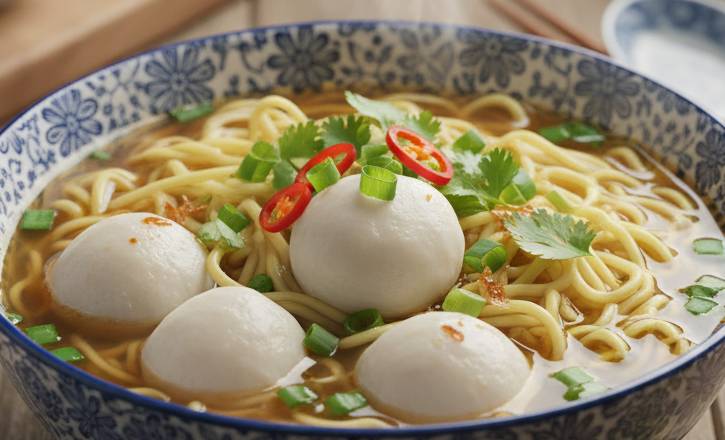
In the professional kitchen, we often speak of “soulful” cooking, but soulfulness is nothing without the support of rigorous technique.
The Fish Ball Noodles recipe is a perfect example of this duality. To the casual observer, it is a simple bowl of comfort. To the chef, it is a complex study in protein extraction, temperature management, and the pursuit of the “snap”—that specific, springy resistance that defines a world-class fish ball.
Elevating this dish requires us to look past the surface. We are not just making a soup; we are constructing a dish where the clarity of the broth and the silkiness of the noodle must meet the precision of a perfectly emulsified fish mousse.
The Mise en Place: Purity and Temperature
When working with delicate seafood, temperature is your most important tool. To achieve a professional result, every component must remain chilled throughout the process.
- The Fish: Seek out fresh, white-fleshed fish with high collagen content, such as Spanish Mackerel or Wolf Herring. It must be impeccably fresh—smelling of the sea, not “fishy.”
- The Binder: We use a touch of tapioca starch, not to mask the fish, but to provide a cohesive structure.
- The Broth: A clean, transparent stock made from the bones of the fish, aromatics, and a whisper of white peppercorn.
The Execution: A Disciplined Approach
I. The Emulsion (The Creation of the “Snap”)
The secret to a superior fish ball lies in the “Tanmo”—the process of beating the fish paste to develop its elastic texture.
- Chilled Processing: Place your fish fillets in a food processor or a heavy mortar. It is essential that the fish remains near freezing.
- The Extraction: Add a precise amount of ice-cold salt water. Salt is the catalyst that extracts the myosin protein, which creates the “bounce.”
- The Aeration: Beat the paste in a singular direction until it becomes tacky, glossy, and holds its shape. This is an exercise in focus and stamina.
II. The Poach: Gentle Heat
- Shape the balls using a wet spoon or your hand, dropping them into a bath of cold salted water first. This allows them to set their shape without the trauma of high heat.
- Bring the water to a very gentle simmer—never a boil. A boil will create air pockets and a “spongy” texture. We want a smooth, dense, velvety finish.
III. The Broth: A Study in Clarity
- Rinse the fish bones thoroughly to remove any impurities.
- Simmer the bones with ginger, scallions, and a touch of rock sugar for a subtle sweetness.
- The Clarification: Skim the surface constantly. We are looking for a broth that is as clear as a consommé but carries the deep, briny essence of the ocean.
IV. The Assembly: The Final Composition
- Prepare your noodles (be they egg noodles or rice vermicelli) à la minute. They should be firm—what the Italians call al dente.
- Place the noodles in a warmed bowl. Arrange the fish balls with intention.
- Ladle the hot, transparent broth over the top. Finish with a precise chiffonade of scallions and a drop of toasted garlic oil.
The Final Touch
When you present a bowl of Fish Ball Noodles, you are offering more than just sustenance; you are offering a testament to the beauty of the process. The snap of the fish ball against the silkiness of the noodle, bathed in a broth that tastes of nothing but purity—this is the definition of culinary finesse.
While others may follow a simple Fish Ball Noodles recipe, you have engaged in the craft of transformation. You have taken humble ingredients and, through discipline and respect, turned them into something extraordinary.
FAQ
1. Why is it essential to keep the fish paste cold during the grinding process?
In culinary science, heat is the enemy of emulsion. If the fish paste warms up during processing, the proteins will begin to denature and the fats will separate.
This results in a soft, grainy fish ball rather than one with a firm “snap.” By using chilled fish and ice water, we maintain the protein structure necessary for that iconic springy texture.
2. Can I use frozen fish for this recipe?
While fresh is always the gold standard, you may use high-quality frozen white fish, provided it has been thawed correctly in the refrigerator.
However, be cautious: frozen fish often loses moisture (drip loss), which can affect the binding capability of the proteins. You may need to adjust your starch ratio slightly to compensate for the loss of natural elasticity.
3. What is the role of salt in making the fish balls “bouncy”?
Salt is not merely a seasoning; it is a functional ingredient. Salt dissolves the muscle fibers (myosin) in the fish, allowing them to cross-link and form a gel-like matrix.
Without the correct amount of salt and vigorous agitation, your fish balls will simply fall apart in the broth. It is the catalyst for the “bounce.”
4. My broth is cloudy. How can I achieve the “transparent” look you describe?
Cloudiness is usually the result of a rolling boil or blood remaining on the fish bones. To achieve a crystal-clear broth, you must blanch the bones in boiling water for two minutes first, then discard that water and rinse the bones clean.
Start your stock again with fresh cold water and never let it go beyond a bare simmer (the “lazy bubble”).
5. How do I know if the fish paste is ready to be shaped?
We use the “Float Test.” Take a small spoonful of your finished paste and drop it into a bowl of room-temperature water.
If it floats immediately, you have incorporated enough air and developed enough protein tension. If it sinks, you must continue to beat the paste.
6. Why do we poach the fish balls in sub-boiling water?
A violent boil creates steam pockets inside the fish ball, which leads to a porous, spongy interior. For a refined, silky, and dense texture, we poach at a gentle 175°F to 185°F.
We are looking for a slow transformation, not a forced one.