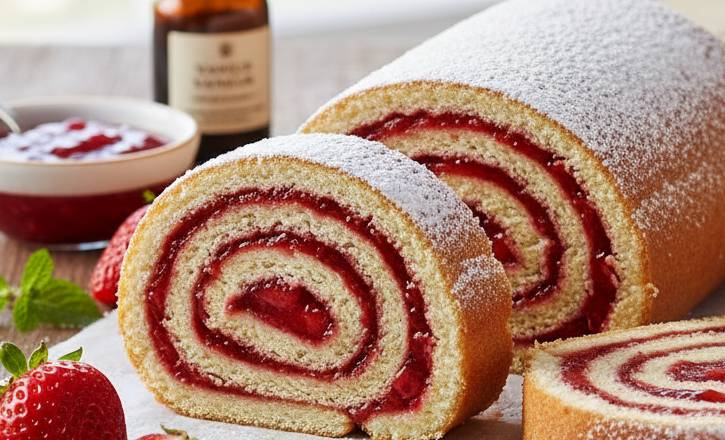
In the world of pastry, there is a profound beauty in repetition and thinness. The Bolo de Rolo, a treasure of Brazilian heritage, is perhaps the ultimate expression of this.
It is not merely a “roll cake”; it is a feat of engineering consisting of layers so thin they become translucent. To execute a strawberry Bolo de Rolo recipe at a professional level, we must move beyond the casual. We must focus on the uniformity of the batter, the purity of the fruit, and the discipline of the roll.
In my kitchens, we emphasize that “finesse” is the result of many small things done correctly. When you master this cake, you are not just baking; you are practicing the art of the delicate.
The Foundation: Precision Ingredients
Note: To achieve the necessary flexibility and silkiness, we measure by weight. A gram scale is your most essential tool here.
- Prep time: 45 minutes
- Bake time: 3–4 minutes per layer
- Yields: 1 large, multi-layered roll
For the Micro-Thin Sponge:
- 200g Unsalted European-style butter (softened to 70°F)
- 200g Superfine granulated sugar
- 200g All-purpose flour (sifted twice)
- 200g Large eggs (approximately 4 eggs), room temperature
- 2g Fine sea salt
For the Strawberry Reduction (The Filling):
- 400g Fresh organic strawberries (hulled and sliced)
- 150g Granulated sugar
- 10g Fresh lemon juice
- Note: The filling must be strained through a chinois to ensure it is perfectly smooth.
Methodical Execution: Step-by-Step
Phase 1: The Strawberry Essence
- Macerate: Combine strawberries and sugar in a heavy-bottomed saucepan. Let sit for 15 minutes to release the juices.
- Reduce: Simmer over medium-low heat until the fruit breaks down and the liquid reaches a jam-like consistency.
- Refine: Pass the hot mixture through a fine-mesh sieve (chinois). Discard the seeds and solids. You want a translucent, intense strawberry gel. Let it cool completely.
Phase 2: The Batter (The Emulsion)
- Cream: In a stand mixer with the paddle attachment, cream the butter and sugar on medium speed for 5 minutes until pale and voluminous.
- Emulsify: Add eggs one at a time. It is vital that each egg is fully incorporated before adding the next to maintain the emulsion.
- Incorporate: Fold in the sifted flour and salt by hand using a large spatula. The goal is a batter that is smooth, glossy, and free of air pockets.
Phase 3: The Bake and the Roll
- Preparation: Preheat oven to 350°F (180°C). Line several flat baking sheets with silicone mats or high-quality parchment.
- The Thinness: This is where finesse is required. Spread a very thin layer of batter (about 1–2mm) onto the sheet. It should be so thin you can almost see the mat underneath.
- The Flash Bake: Bake for only 3 to 4 minutes. The cake should be set but not browned. If it browns, it will lose its elasticity and crack.
- The First Roll: Remove the first sheet. While hot, spread a paper-thin layer of the strawberry reduction. Roll it up tightly. This is your core.
- The Continuous Layering: Bake the second sheet. Spread the jam. Place the “core” at the edge of the new sheet and roll it into the new layer. Repeat this process until all batter and jam are used.
Conclusion: The Beauty of the Process
The strawberry Bolo de Rolo recipe is a lesson in patience. When you look at the final slice and see twenty or thirty distinct, razor-thin layers, you see the time and care invested in the dish.
It is a sophisticated centerpiece that honors both the ingredient and the technician. Serve it simply—perhaps with a light dusting of superfine sugar—and let the layers speak for themselves.
FAQ
Q: Why did my cake crack during the rolling process?
A: This is almost always a result of overbaking. In this strawberry Bolo de Rolo recipe, the moisture in the cake is what provides the flexibility. If the edges are crisp or the surface is golden, the proteins have set too firmly. The cake must remain pale.
Q: Can I use store-bought strawberry jam?
A: I would discourage it. Commercial jams often contain pectin and stabilizers that create a “rubbery” mouthfeel. A house-made reduction provides a cleaner, more vibrant acidity that cuts through the richness of the butter sponge.
Q: How do I get those perfect, clean circular layers on the ends?
A: The secret is the “trim.” Once the roll is complete and has rested, use a very sharp, hot serrated knife to slice off the uneven ends. This reveals the beautiful, concentric circles that signify a professional execution.