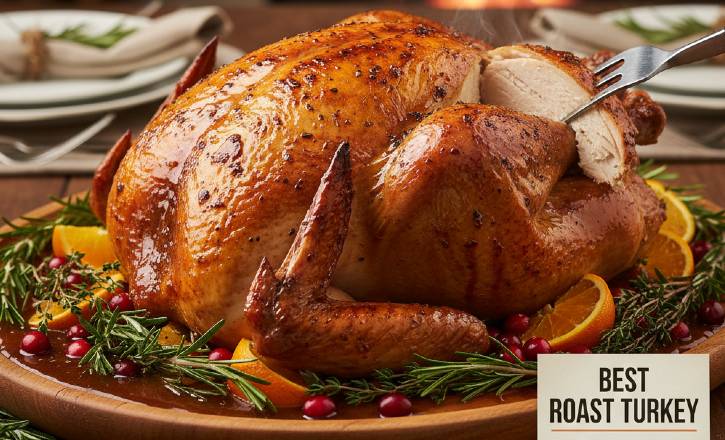
In the professional kitchen, we often say that the simplest dishes are the most difficult to execute perfectly.
The roast turkey is the quintessential example. It is a centerpiece that demands respect, not just for its size, but for the delicate balance between rendering the fat for a crisp, golden skin and preserving the moisture within the lean breast meat.
To achieve the best roast turkey recipe for moist results, we must move away from the “hope and pray” method of traditional home roasting.
Instead, we embrace a disciplined approach: the brine, the truss, and the high-heat finish. By treating the bird with intention, we transform a seasonal obligation into a culinary triumph.
The Foundation: The Brine
The secret to a moist turkey is not found in the oven, but in the 24 hours preceding it. Brining is a non-negotiable step. It seasons the bird deeply and, through osmosis, increases the moisture-holding capacity of the muscle fibers.
- Yields: Serves 10–12 Prep time: 45 minutes (plus 24-hour brine) Roast time: Approximately 2.5–3 hours
The Brine Ingredients:
- 5 gallons Water
- 1 lb. Kosher salt
- 1/2 cup Honey
- 1 head of Garlic, halved horizontally
- 6 Bay leaves
- 2 tbsp. Black peppercorns
- 1 large bunch of Fresh Thyme
- 1 bunch of Italian Parsley
- 2 Lemons, halved
The Methodical Execution
Step 1: The Brining Process
- Prepare the Aromatics: In a large pot, combine 1 gallon of water with the salt, honey, and aromatics. Bring to a simmer, stirring until the salt is dissolved.
- Chill: Remove from heat and add the remaining cold water. It is imperative that the brine is ice-cold before the turkey is submerged.
- Submerge: Place your 12–14 lb. turkey in a large, food-grade bucket or brining bag. Pour the cold brine over it, ensuring it is fully covered. Refrigerate for exactly 24 hours.
Step 2: The Drying (The Key to Crispy Skin)
- Remove and Rinse: After 24 hours, remove the turkey from the brine. Rinse it thoroughly under cold water and pat it excessively dry with paper towels.
- Air-Dry: For the absolute best results, place the turkey on a rack over a baking sheet and leave it uncovered in the refrigerator for another 12–24 hours. This dries the skin, allowing it to shatter like glass once roasted.
Step 3: Preparation and Trussing
- Temper: Remove the turkey from the refrigerator 2 hours before roasting. We never put a cold bird into a hot oven; bringing it to room temperature ensures even cooking.
- Truss: Tuck the wings behind the back and tie the legs together with kitchen twine. A compact bird roasts more evenly, protecting the breast meat from overexposure.
- Season: Season the cavity with salt and pepper. Rub the skin with a thin layer of clarified butter or neutral oil. Do not use whole butter here, as the milk solids will burn at the high temperatures we are about to use.
Step 4: The Roast
- High Heat: Preheat your oven to 450°F (230°C). Many are intimidated by this temperature, but it is essential for the best roast turkey recipe for moist meat. High heat cooks the bird faster, meaning less time for the juices to evaporate.
- Monitor: Place the turkey on a roasting rack in a heavy pan. Roast until the internal temperature of the thickest part of the thigh reaches 160°F (71°C). The residual heat will carry it to the perfect 165°F during the rest.
- Baste sparingly: Only baste in the final 30 minutes if necessary. Opening the oven door frequently drops the temperature and disturbs the cooking rhythm.
Step 5: The Rest (The Most Important Step)
- Patience: Once removed from the oven, the turkey must rest for at least 30 to 45 minutes. Do not tent it with foil, as this will steam the skin and make it soft. Resting allows the juices to redistribute from the center back into the meat. If you carve too soon, the moisture will end up on your cutting board rather than on the plate.
A Chef’s Conclusion
A great meal is not defined by its complexity, but by the integrity of its execution. When you follow this path—the patience of the brine, the discipline of the dry, and the courage of the high heat—you are rewarded with more than just a meal.
You are rewarded with the knowledge that you have treated your ingredients with the highest level of care.
This is the best roast turkey recipe for moist, flavor-forward results because it relies on technique over gadgets. Serve it simply, perhaps with a refined jus and root vegetables, and let the quality of the bird speak for itself.
FAQ
Q: Why do you recommend roasting at 450°F? Won’t that burn the skin before the meat is cooked?
A: This is a common concern, but high-heat roasting is precisely what ensures the best roast turkey recipe for moist meat. By cooking the bird quickly at a high temperature, you minimize the time the turkey spends in the dry heat of the oven, which prevents the moisture from evaporating.
If your turkey is properly dried and tempered (brought to room temperature) before entering the oven, the skin will turn a deep, mahogany gold just as the interior reaches the perfect temperature.
Q: Is it really necessary to brine for a full 24 hours?
A: Discipline in timing is essential. Twenty-four hours allows the salt to penetrate the deep muscle tissues of the breast and thigh. If you brine for too short a time, only the surface is seasoned; if you go too long, the texture of the meat can become “cured” or ham-like.
Precision is the difference between a good meal and an extraordinary one.
Q: Should I stuff the turkey with bread stuffing?
A: From a culinary standpoint, I advise against it. Stuffing the cavity acts as an insulator, requiring the bird to stay in the oven longer to ensure the stuffing reaches a safe temperature. This almost inevitably leads to overcooked, dry breast meat.
Instead, place aromatics like lemon, onion, and herbs in the cavity for flavor, and bake your dressing in a separate gratin dish to achieve those desirable crispy edges.
Q: What if the skin is browning too quickly while the internal temperature is still low?
A: Every oven has its own personality. If you find the skin reaching a dark bronze before the thigh hits 160°F, you may gently shield the breast with a small piece of aluminum foil.
However, do not wrap the entire bird, as we want to maintain the dry-heat environment to keep the skin crisp.
Q: Do I need to baste the turkey every 30 minutes?
A: I prefer a “hands-off” approach once the bird is in the oven. Every time you open the oven door, you lose heat and increase the cooking time. If you have properly brined the bird and rubbed the skin with oil or clarified butter, the turkey will self-baste effectively.
Constant basting with liquid can also result in soggy skin, which defeats the purpose of our meticulous drying process.
Q: How do I know for sure the turkey is done without overcooking it?
A: Trust your thermometer, not the clock. Insert a high-quality digital probe into the thickest part of the thigh, being careful not to hit the bone. Remove the turkey when it hits 160°F (71°C).
The “carry-over cooking” that occurs while the bird rests will bring the final temperature to the USDA-recommended 165°F without sacrificing the moisture.