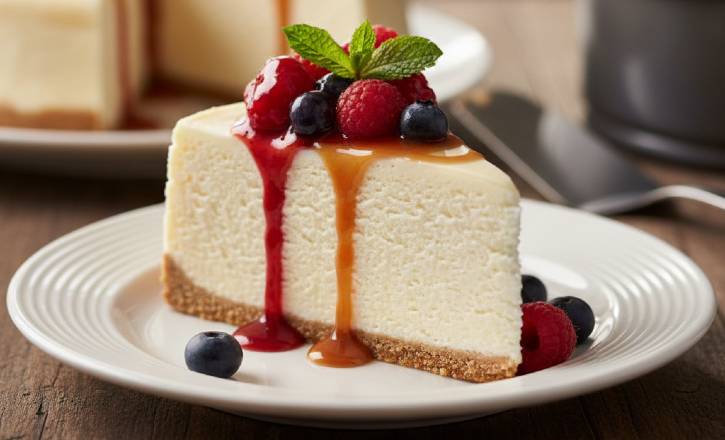
We’ve all been there. You spend hours meticulously crafting what you hope will be a picture-perfect cheesecake—only to pull it out of the oven and find a gaping, ugly crack running right across the top. It’s the ultimate baking betrayal.
The truth is, achieving that velvety, smooth, crack-free finish takes more than just mixing ingredients; it takes technique.
After years of trial and error, we’ve perfected the method. Forget complicated water baths and excessive fuss. This is, without a doubt, the Best Creamy Cheesecake Recipe Ever, guaranteed to deliver that perfect, decadent slice every time.
The Ingredients (What You’ll Need)
For the Crust
- 1 ½ cups Graham cracker crumbs (about 12 full sheets)
- ⅓ cup granulated sugar
- 6 tablespoons (3 oz.) melted unsalted butter
For the Filling
- 4 (8 oz.) packages full-fat cream cheese, softened to room temperature (Crucial Step!)
- 1 ½ cups granulated sugar
- 1 teaspoon pure vanilla extract
- ½ cup sour cream (full fat, room temperature)
- 4 large eggs, room temperature
Instructions (The Foolproof Method)
Follow these steps precisely to ensure that rich, creamy texture and a crack-free top.
Step 1: Prep and Crust
- Preheat your oven to 350°F (175°C). Wrap the outside of a 9-inch springform pan tightly with heavy-duty aluminum foil.
- Combine the graham cracker crumbs, ⅓ cup sugar, and melted butter. Press the mixture firmly into the bottom of the prepared pan.
- Bake the crust for 8 to 10 minutes. Remove and let cool slightly while preparing the filling. Reduce the oven temperature to 325°F (160°C).
Step 2: Mixing the Filling
- In a large bowl, use a hand mixer or stand mixer on low speed to beat the softened cream cheese until perfectly smooth. Avoid high speed—air bubbles are the enemy of a smooth cheesecake!
- Gradually beat in the 1 ½ cups of sugar until just combined. Mix in the vanilla and sour cream.
- The Gentle Egg Addition: Add the eggs one at a time, mixing only until the yolk disappears after each addition. Stop mixing immediately once the last egg is incorporated. Over-mixing the eggs is the main cause of cracks.
Step 3: The Slow Bake
- Pour the filling over the cooled crust.
- Optional Water Bath (Recommended): Place the foil-wrapped springform pan inside a larger baking pan. Carefully pour boiling water into the larger pan until it reaches halfway up the side of the springform pan.
- Bake for 60 to 75 minutes. The center should still look slightly wobbly (like firm Jell-O) when you gently shake the pan.
Step 4: The Shockingly Simple No-Crack Cooling Step
This is the moment that separates a good cheesecake from the Best Creamy Cheesecake Recipe Ever:
- Turn off the oven.
- Leave the cheesecake inside the turned-off oven with the door slightly ajar (use a wooden spoon to prop it open).
- Let the cheesecake cool slowly inside the oven for 1 hour. This gradual decrease in temperature prevents the surface from shocking and cracking.
- Remove the cheesecake from the oven and carefully remove the foil and water bath (if used). Let it cool completely on a wire rack for another hour.
Step 5: Chill and Serve
- Once completely cooled to room temperature, cover the cheesecake loosely and refrigerate for a minimum of 6 hours, but preferably overnight.
- When ready to serve, run a thin knife dipped in hot water around the edge of the pan before removing the springform ring.
Conclusion
That’s it. By focusing on room temperature ingredients, gentle mixing, and the slow, controlled cool-down in the oven, you eliminate the stress and the cracks.
The result is a cheesecake with a dense, creamy body and a velvety smooth top that will make you feel like a professional baker. This isn’t just a recipe; it’s your definitive guide to the Best Creamy Cheesecake Recipe Ever.
Go ahead, try it—we dare you to find a single crack!
Ready to impress your guests? We can help you find the best toppings, like a classic berry sauce or salted caramel.
FAQ
Q: Why are room temperature ingredients so important?
A: This is critical for achieving a creamy, lump-free filling. Cold cream cheese will resist blending with the sugar and eggs, leading to over-mixing. Over-mixing introduces air, and air is the primary cause of cracks during the cooling process.
Always let your cream cheese and eggs sit out for at least 30 minutes.
Q: I don’t have a water bath pan. Can I skip the water bath entirely?
A: Yes, you can skip the traditional water bath, but you cannot skip the slow cool-down. The slow cool-down in the turned-off oven (Step 4) is the most critical element to prevent temperature shock and cracking. If you skip the water bath, be sure your oven temperature is accurate and you strictly follow the one-hour cooling rule inside the oven.
Q: My cheesecake still cracked. What went wrong?
A: The crack is usually caused by one of two things:
- Over-Mixing the Eggs: You must stop mixing immediately after the eggs are just incorporated. Beating the eggs creates air pockets that expand during baking and collapse upon cooling.
- Too Fast Cooling: Removing the cheesecake from the hot oven too quickly causes a rapid temperature change, making the surface contract and crack.
Q: Can I use low-fat cream cheese or Greek yogurt?
A: While you can use low-fat cream cheese, it will compromise the final texture. For the Best Creamy Cheesecake Recipe Ever, the high-fat content is necessary for that signature density and richness.
Substituting sour cream with Greek yogurt may also work, but the texture might be slightly denser and less smooth.
Q: How long will this cheesecake keep in the refrigerator?
A: When covered tightly with plastic wrap or stored in an airtight container, your cheesecake will last wonderfully in the refrigerator for up to 5 days. Cheesecake also freezes very well; wrap slices tightly and freeze for up to 1-2 months.