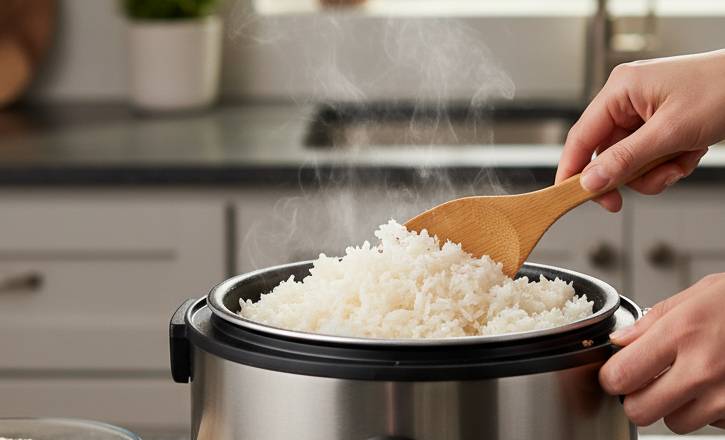
In the professional kitchen, we often say that the way a chef prepares an egg or a pot of rice reveals their true discipline.
There is a profound beauty in the fundamentals. To understand how to cook easy cooked rice is not to look for a shortcut, but to embrace a refined process that yields a consistent, elegant result.
When we strip away the complexity of modern cuisine, we are left with the integrity of the grain. Our goal is a pot of rice where every grain is distinct, translucent, and tender—never muted by excess starch or uneven heat.
The Philosophy of the Grain: Sourcing and Preparation
The secret to excellence lies in the mise en place. Before the heat is ever applied, we must respect the ingredient. For a versatile, clean finish, I prefer a long-grain white rice, such as Jasmine or Basmati, for its aromatic clarity.
The Essential Tools
- A Heavy-Bottomed Saucepan: Even heat distribution is paramount to prevent scorching at the base.
- A Tight-Fitting Lid: Steam is our primary cooking medium; we cannot afford for it to escape.
- A Fine-Mesh Sieve: For the most critical step—the rinse.
The Execution: Step-by-Step
1. The Purification (The Rinse)
Place your dry rice in a fine-mesh sieve. Run cold, filtered water over the grains, agitating them gently with your fingers. We do this to remove the surface starch. Continue until the water running from the sieve is perfectly clear. If the water is cloudy, your rice will be gummy. In our kitchens, clarity is non-negotiable.
2. The Ratio of Precision
While many home cooks rely on intuition, we rely on the ratio. For a standard long-grain rice, use a 1:1.5 ratio. That is one part rice to one-and-a-half parts liquid.
“Precision is the foundation of consistency. If you measure with care, the ingredient will reward you.”
3. The Toast and Seasoning
Place the rinsed rice into the saucepan. Add a small knob of unsalted butter or a teaspoon of neutral oil and a pinch of Kosher salt. Over medium heat, stir the rice for 60 seconds. You aren’t looking to brown the rice, but rather to “pearl” it—coating each grain in a thin layer of fat to ensure they remain separate after cooking.
4. The Gentle Simmer
Add your water (or a light vegetable stock for depth). Bring it to a simmer—not a rolling boil. As soon as the surface begins to dance, reduce your heat to the lowest possible setting and secure the lid.
5. The Discipline of Silence
Cook for 15 minutes. During this time, do not lift the lid. Every time you “peek,” you release the pressurized steam and drop the temperature, which compromises the texture of the grain. Trust the process.
The Final Flourish
Once the timer expires, remove the pan from the heat, but keep the lid sealed. Let it rest for 10 minutes. This resting period allows the moisture to redistribute, ensuring the rice at the top is as hydrated as the rice at the bottom.
When you finally reveal the rice, use a fork to fluff it gently. A spoon can smash the grains; a fork allows them to breathe.
Conclusion
Mastering how to cook easy cooked rice is an exercise in culinary mindfulness. It is a reminder that even the simplest preparations, when executed with the standards of a professional, can be a source of great pride. Served simply with a touch of sea salt or as a canvas for a complex sauce, it is perfection in a bowl.
FAQ
1. Why is rinsing the rice considered a non-negotiable step?
Rinsing is about the removal of excess surface starch. If left on the grain, that starch gelatinizes during the cooking process, causing the rice to become sticky or “clumpy.” To achieve the distinct, individual grains found in a professional kitchen, you must rinse until the water is completely transparent.
2. Can I use a rice cooker instead of the stovetop method?
A rice cooker is a tool of convenience, and many are quite excellent. However, using a heavy-bottomed saucepan on the stove allows you to toast the grain in butter first—a process known as nacre—which adds a layer of flavor and textural integrity that a standard machine cannot replicate.
3. What should I do if the rice is still too firm after the allotted time?
This usually indicates that the seal on your lid was not tight enough, allowing steam to escape. If this occurs, add two tablespoons of boiling water, return the lid quickly, and let it sit on the lowest heat for an additional five minutes. Never add cold water, as it shocks the grain.
4. Why do you recommend Kosher salt over table salt?
In our kitchens, we prefer Kosher salt for its clean flavor and its ability to dissolve evenly. Table salt often contains anti-caking agents and iodine, which can impart a subtle metallic bitterness to a neutral canvas like white rice.
5. Is it possible to over-fluff the rice?
Yes. You should fluff the rice only once, just before serving. Excessive agitation breaks the grains and releases internal starches, which can turn a fluffy pot of rice into a gummy one. Use a folding motion with a fork to lift and separate.
6. Can I substitute the water with other liquids?
Absolutely. While water provides the purest expression of the grain, using a clarified chicken bouchée or a light vegetable fumé can add incredible depth. If using a stock, ensure it is low-sodium so you can maintain total control over the seasoning of the dish.