In the culinary arts, “comfort food” is often used as an excuse for a lack of discipline.
However, at the highest level, a dish like Bangers and Mash is an opportunity to showcase finesse through the management of temperature and the emulsification of fats. To truly master how-to-cook-bangers-and-mash-juicy, one must respect the sausage as a delicate forcemeat and the potato as a canvas for high-quality butter.
We are not merely “cooking” a meal; we are executing a series of precise movements to ensure the protein retains its moisture and the starch achieves a cloud-like levity.
The Mise en Place
The quality of your output is capped by the quality of your input.
- The Bangers: Seek out high-quality, heritage-breed pork sausages with a natural casing. The casing is the vessel that preserves the juices.
- The Potatoes: Yukon Gold. Their waxier composition allows for a smoother, more velvet-like pomme purée.
- The Dairy: Unsalted European-style butter (high fat content) and heavy cream, tempered to room temperature.
- The Jus: A reduced veal stock or high-quality beef bone broth, enriched with caramelized shallots and a touch of cold butter (monter au beurre).
The Execution: A Protocol for Perfection
I. The Gentle Tempering
Before the sausage ever touches a pan, it must be brought to room temperature. Taking a cold sausage and placing it on a hot surface causes the casing to contract violently and tear, leaking the precious fats we aim to keep inside. Tempering is the first step in ensuring your bangers remain juicy.
II. The Controlled Searing (The “Slow and Low” Method)
We avoid aggressive, high-heat searing. Instead, use a heavy-bottomed copper or cast-iron pan over medium-low heat.
- Add a film of neutral oil and a knob of butter.
- Place the sausages in the pan, listening for a gentle whisper, not a harsh sizzle.
- Turn them frequently. This “constant motion” technique ensures the heat penetrates the center evenly without over-extending the exterior proteins. We are looking for a uniform, golden-amber hue.
III. The Potato Emulsion (Pomme Purée)
While the sausages rest—a mandatory step to allow the juices to redistribute—we turn to the potatoes.
- Peel and boil the Yukon Golds in heavily salted water until just tender.
- Pass them through a food mill or ricer. Never use a blender; we must not overwork the starch.
- Incorporate the butter first. The fat coats the starch molecules, resulting in a silkier mouthfeel. Slowly fold in the tempered cream until the consistency is light and aerated.
IV. The Onion Jus
In the same pan used for the sausages, sauté thinly sliced shallots until they reach a deep mahogany. Deglaze with your stock, reducing it until it coats the back of a spoon (nappe consistency). Strain this through a fine-mesh chinois for a professional, debris-free finish.
The Plating
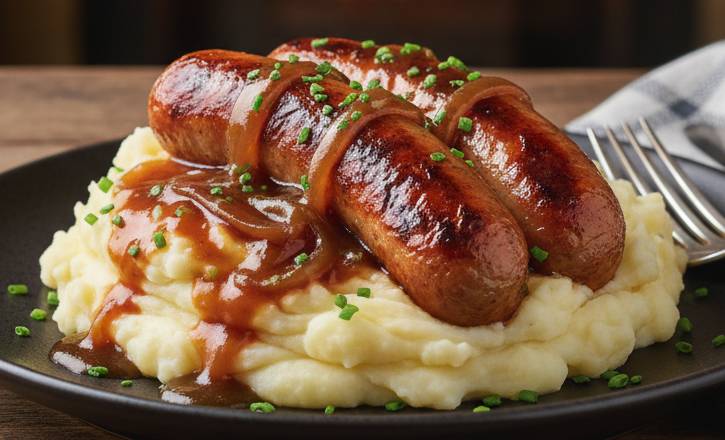
Plating is the final act of respect for the ingredient. Spoon a generous mound of the pomme purée onto the center of a warm plate, creating a slight well with the back of the spoon. Nestled atop are the sausages, followed by a refined drizzle of the onion jus.
The result is a dish where the sausage snaps to reveal a moist, seasoned interior, complemented by the richness of the potatoes. This is how the domestic is made professional.
Bon Appétit.
FAQ
Why do my sausages often burst or “split” during cooking?
A split casing is a failure of temperature management. When a sausage is subjected to high heat too quickly, the moisture inside turns to steam and expands faster than the casing can stretch.
By tempering the meat to room temperature and using a medium-low flame, you allow the proteins and fats to expand gradually, preserving the integrity of the casing and keeping the juices trapped inside.
Is there a specific reason for using a food mill instead of a hand mixer for the potatoes?
In the professional kitchen, texture is paramount. A hand mixer or food processor shears the starch granules of the potato, releasing amylose which turns the mixture gummy and glue-like.
A food mill or ricer gently separates the potato solids without damaging the starch, resulting in a light, aerated purée that can properly emulsify with the butter and cream.
How do I ensure the interior of the sausage is cooked without overdoing the outside?
This is achieved through residual heat. We cook the bangers until they reach an internal temperature of approximately 155∘F (68∘C) and then remove them from the pan.
During the resting period, the temperature will carry over to the required 160∘F (71∘C). This “carry-over cooking” is the secret to a result that is safe yet exceptionally juicy.
What is the role of “Monter au Beurre” in the onion gravy?
Monter au beurre (to lift with butter) is the technique of whisking cold butter into a hot sauce at the very end.
This does more than just add flavor; it creates a silky emulsion and a glossy sheen that allows the sauce to coat the sausages elegantly rather than simply running off the plate.
Can the potatoes be prepared in advance?
While we always strive for immediate service, you can pass the potatoes through the ricer and keep them warm in a bain-marie (water bath).
However, the final incorporation of tempered cream and butter should happen as close to service as possible to maintain the vibrancy and emulsion of the fats.