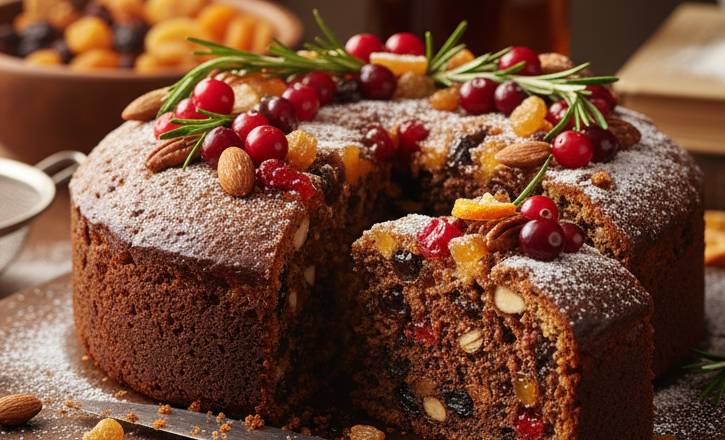
Cooking is not just about heat and ingredients; it is about memory. It is about the way a specific texture or aroma can transport you back to a moment in time. The Sugee cake—a dense, rich semolina cake steeped in Eurasian tradition—is one of those confections that demands our respect.
It is not a sponge cake, and it is not a pound cake. It occupies its own category of excellence. The crumb is unique—granular yet velvety, owing to the semolina (sugee). But to achieve that specific “melt-in-your-mouth” quality requires patience. We cannot rush the process. We must allow the semolina to bloom, the butter to aerate, and the flavors to mature.
In my kitchens, we believe that if you are going to spend the time to make something, you must commit to making it perfect. This Sugee fruit cake recipe is an exercise in restraint and technique, yielding a result that is both rustic and incredibly refined.
The Philosophy of Ingredients
Before we turn on the oven, we must address our mise en place. The success of this cake relies on three pillars:
- The Semolina: It must be fine. We are looking for texture, not grit.
- The Butter: Use the highest quality salted butter you can find. The salt content balances the richness of the almonds and brandy.
- The Fruit: Macerated well in advance. Dry fruit pulls moisture from the cake; brandied fruit gives it back.
Ingredients
For the Semolina Soak:
- 250g Salted Butter (high quality, room temperature)
- 150g Semolina flour (fine grade)
For the Cake Base:
- 150g All-purpose flour (sifted)
- 1/2 tsp Baking powder
- 1/2 tsp Sea salt
- 1 tsp Ground spices (a blend of cinnamon, nutmeg, and clove)
- 250g Castor sugar
- 5 Large egg yolks
- 5 Large egg whites
- 50g Ground almonds (almond meal)
- 1 tsp Pure vanilla bean paste or extract
- 2 tbsp High-quality Brandy (plus more for brushing)
The Fruit Inclusion:
- 150g Mixed dried fruits (sultanas, cherries, orange peel), chopped and soaked in brandy for at least 24 hours.
The Execution
Phase I: The Bloom (Mise en Place)
The most critical error in a Sugee fruit cake recipe is rushing the hydration of the semolina.
- In a bowl, combine the 250g of butter and the 150g of semolina.
- Cover this mixture and let it rest at room temperature for at least 4 hours, though overnight is preferable.
- Why we do this: The fat encapsulates the semolina grains, softening them. This ensures the cake is moist rather than sandy.
Phase II: The Emulsion
Preheat your oven to 320°F (160°C). Grease and line an 8-inch square pan with parchment paper.
- Creaming the Yolks: In a stand mixer, beat the egg yolks and castor sugar until they reach the “ribbon stage”—pale, thick, and falling in ribbons from the whisk.
- Integrating the Semolina: Gently fold your rested butter-semolina mixture into the yolk mixture. Do not whip it; we want to maintain the structure. Add the vanilla and brandy.
- Dry Ingredients: Sift the flour, baking powder, salt, spices, and almond meal together. Fold this into the batter in three batches.
- The Fruit: Toss your drained macerated fruits in a tablespoon of flour (to prevent sinking) and fold them into the batter.
Phase III: The Aeration
- In a clean copper or steel bowl, whip the egg whites to stiff peaks. Do not overbeat to the point of dryness; we want glossy, firm peaks.
- The Fold: This is the moment of finesse. Take one-third of the whites and sacrifice them—stir them into the heavy batter to loosen it. Then, gently fold in the remaining two-thirds of the whites. Use a large spatula and cut through the center, sweeping up the sides. Stop as soon as the streaks of white disappear.
Phase IV: The Bake
- Pour the batter into your prepared pan. Smooth the top with an offset spatula.
- Bake for 45 to 55 minutes.
- The cake is done when a skewer inserted into the center meets just a whisper of resistance, coming out clean but not dry.
Finishing and Service
When you pull the cake from the oven, resist the urge to cut it immediately. Brush the top generously with brandy while it is still warm. Let it cool completely in the pan.
Ideally, wrap the cake in parchment and foil and let it mature for 24 hours. The flavors need this time to marry. The semolina will continue to soften, and the brandy will permeate the crumb.
Slice it precisely. Serve it simply. A cake of this caliber requires no garnish, perhaps only a cup of black coffee or tea. It is a testament to the fact that when we treat humble ingredients with dignity, we create something extraordinary.
FAQ
1. Why must the semolina soak in butter for several hours?
In the culinary arts, patience is often the most important ingredient. Semolina is a resilient, coarse grain. By allowing it to macerate in the fat of the butter, we soften the grain’s exterior.
This ensures that the final crumb is velvety and tender rather than gritty or sandy. Rushing this step fundamentally changes the texture of the cake.
2. Can I substitute the brandy with a non-alcoholic alternative?
While brandy provides a specific depth of flavor and acts as a preservative for the fruit, you may substitute it with a high-quality fresh orange juice or a vanilla bean infusion.
However, keep in mind that the flavor profile will shift from a deep, “aged” complexity to something brighter and more floral.
3. My fruit always sinks to the bottom of the cake. How do I prevent this?
This is a matter of physics and preparation. First, ensure your fruit is chopped into uniform, bite-sized pieces. Second, after draining your macerated fruit, toss it lightly in a small amount of flour.
This creates a “grip” between the fruit and the batter, allowing the fruit to remain suspended during the baking process.
4. Is it possible to use almond flour instead of ground almonds (almond meal)?
Yes, though I prefer almond meal for its rustic integrity. Almond flour is more finely sifted and will result in a slightly more delicate, less textured cake.
Ensure your almond product is fresh; the oils in nuts can turn rancid quickly, which will compromise the clean flavor of the butter.
5. How long will this Sugee fruit cake stay fresh?
Because of the high fat content and the presence of brandy, this cake ages beautifully. When wrapped tightly in parchment and stored in an airtight container, it will stay fresh at room temperature for up to 5 days.
For longer storage, it can be refrigerated for two weeks, though I recommend bringing it to room temperature before serving to allow the butter to soften.
6. Why do we separate the eggs and whip the whites separately?
Aeration. A Sugee cake is naturally dense due to the weight of the semolina and nuts. By folding in “stiff-peak” egg whites at the final stage, we introduce microscopic air bubbles that lift the batter.
This creates a balance between richness and lightness—the hallmark of a sophisticated dessert.