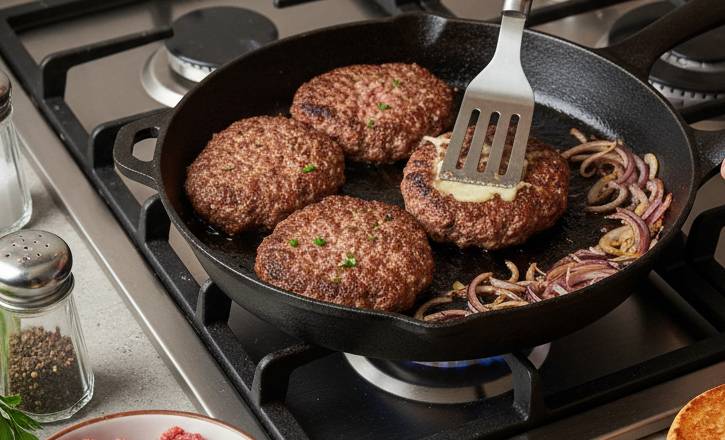
We often approach the burger with a sense of casualness that belies its potential for perfection.
In the professional kitchen, we understand that a burger is not merely “fast food,” but a composition of fat, protein, and heat that requires the same level of discipline as a dry-aged côte de boeuf. When we move away from the grill and toward the frying pan, we gain a distinct advantage: the ability to achieve a continuous, edge-to-edge Maillard reaction.
By carefully managing the contact between the chilled, loosely packed mince and the radiant heat of a heavy-bottomed skillet, we create a profound contrast—a deeply caramelized, savory crust yielding to a tender, succulent interior.
It is a reminder that when we respect the integrity of our ingredients and the precision of our heat, even the most humble preparation can become an extraordinary culinary experience.
The Mise en Place: Preparation with Intent
Before the pan even touches the flame, we must consider the architecture of the mince. For a burger that rivals any fine-dining entree, the quality of your beef is paramount.
- The Blend: Seek a 75/25 or 80/20 lean-to-fat ratio. Fat is not merely a byproduct; it is the vehicle for flavor and the insurance policy for moisture.
- The Temperature: Keep your mince cold. Cold fat stays within the meat during the initial sear; warm fat melts away, leaving you with a dry, crumbly texture.
- The Shape: Divide your mince into 6-ounce portions. Handle the meat with a “light touch”—overworking the protein develops myosin, which leads to a tough, sausage-like consistency. We want a delicate, airy crumb.
The Process: How to Make Burgers from Mince in a Frying Pan
To execute this correctly, one must understand the relationship between the surface of the pan and the surface of the meat.
- Tempering the Pan: Place a heavy cast-iron or stainless-steel skillet over medium-high heat. We are looking for a state of “shimmering” heat. Add a high-smoke-point oil (such as grapeseed) only once the pan is hot.
- The Seasoning: Seasoning is an act of precision. Use kosher salt and freshly cracked black pepper. Hold your hand at least 12 inches above the patties to ensure an even, snow-like distribution. Season only the side that will hit the pan first, and do so immediately before cooking to prevent the salt from drawing out moisture prematurely.
- The Initial Contact: Lay the patty into the pan away from you to avoid splashing. You should hear a vigorous, immediate sizzle. This is the sound of the Maillard reaction beginning. Use a heavy spatula to press down once—and only once—to ensure total surface contact.
- Managing the Sear: Allow the burger to cook undisturbed for approximately 3 to 4 minutes. We are looking for a “GBD” (Golden Brown and Delicious) crust. Flip only when the meat releases naturally from the pan.
- The Butter Baste (The Arrosé): In the final minute of cooking, add a knob of unsalted butter and a sprig of thyme to the pan. Tilt the skillet and spoon the foaming, aromatic butter over the patty. This adds a layer of luxurious silkiness that a grill simply cannot provide.
The Finish: Respecting the Rest
The most common error in the home kitchen is the rush to serve. Once the internal temperature reaches your desired point (I recommend 130∘F to 135∘F for medium-rare), remove the patty from the pan.
Transfer the burger to a wire rack set over a sheet pan. Resting is non-negotiable. Allow the fibers to relax and the juices to redistribute for at least five minutes. This ensures that the moisture stays within the meat, rather than escaping onto the plate.
Conclusion
Learning how to make burgers from mince in a frying pan is more than a convenience; it is a masterclass in heat management. When we treat the burger with the same reverence as a piece of turbot or a rack of lamb, we elevate the act of eating into an act of appreciation.
It is about the ritual of the sear, the clarity of the seasoning, and the patience of the rest.
FAQ
1. Why choose a frying pan over an outdoor grill?
In the professional kitchen, we prioritize the “crust.” A heavy-bottomed frying pan, such as cast iron, provides continuous surface contact.
This allows for a uniform Maillard reaction—a deep, savory caramelization—across the entire face of the patty, which a grill grate simply cannot achieve. Furthermore, the pan allows us to baste the meat in its own fats and aromatic butter.
2. Which oil is best for pan-searing mince?
Precision requires an oil with a high smoke point and a neutral profile. Grapeseed oil is my preferred choice; it allows the flavor of the beef to remain the protagonist without the bitter notes of burnt fats.
Avoid extra virgin olive oil for this high-heat application, as its solids will scorch.
3. Should I press the patty while it is cooking?
You may apply a firm, even pressure once—immediately after the patty makes contact with the hot steel—to ensure total surface adherence. After that, you must refrain from pressing.
To do so later in the process forces out the internal juices and fats that are essential for a succulent mouthfeel.
4. How can I ensure the burger doesn’t “puff up” in the center?
This is a matter of physics. As the proteins in the mince contract from the heat, they push the center upward. To counteract this, use your thumb to create a slight indentation, or “dimple,” in the center of the raw patty.
As the meat cooks, the center will rise to meet the edges, resulting in a perfectly flat surface for your garnishes.
5. Why is resting the meat so critical?
Resting is the final step of the cooking process. When the meat is subjected to intense heat, the juices are pushed toward the center. By allowing the burger to rest on a wire rack for five minutes, you allow the muscle fibers to relax and the moisture to redistribute evenly.
If you cut into it too soon, the flavor ends up on the cutting board rather than in the dish.
6. What is the ideal fat-to-lean ratio for a pan-seared burger?
For a burger with proper integrity and flavor, a ratio of 80% lean to 20% fat is the benchmark. The fat provides the necessary lubrication for the protein and carries the seasoning throughout the palate.
Anything leaner will result in a dry, lackluster texture.