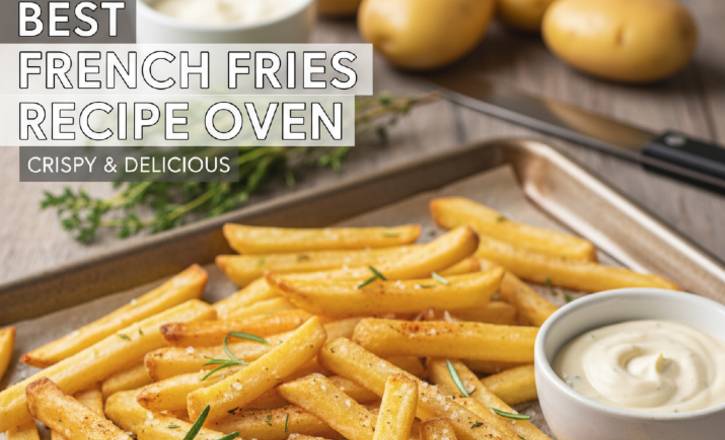
In the professional kitchen, we often say that the simplest preparations are the most difficult to master.
There is no place for mediocrity when dealing with a dish as iconic as the French fry. While the traditional double-fry method in oil remains the gold standard at Bouchon, achieving a result of equal merit in a domestic oven is a pursuit of discipline and technical accuracy.
To produce the best French fries recipe oven-style, one must move beyond the idea of “baking” and instead focus on the total transformation of the starch. We are looking for a glass-like exterior—shattering upon the first bite—yielding to a center that is exceptionally creamy, almost like a purée.
The Mise en Place
Success begins with the integrity of your ingredients. We utilize the Russet potato for its high starch content and low moisture, which is essential for that desired structural contrast.
- Russet Potatoes: 2 lbs, scrubbed and peeled.
- Neutral Fat: Grapeseed oil or clarified butter (for their high smoke points).
- Finishing Salt: Sel Gris or Kosher salt.
- Aromatics: Fresh thyme sprigs and crushed garlic cloves (optional).
The Method: A Three-Phase Approach
I. The Precision Cut
Uniformity is not merely for aesthetics; it ensures a synchronous cook time. Cut your potatoes into batons exactly 1/3-inch thick. Immediately submerge them in an ice-water bath for no less than thirty minutes. This critical step removes excess surface starch, preventing the fries from becoming gummy or oxidizing.
II. The Blanch and Dehydration
Drain the potatoes and pat them dry with absolute care. In a large pot, start them in cold, salted water and bring to a gentle simmer. We are not cooking them to mush; we are “parblanching” until the edges are just tender.
Once drained, spread them on a cooling rack. This is where many home cooks fail: you must allow the surface moisture to evaporate completely. A dry potato is the only path to a crisp potato.
III. The High-Heat Transformation
- Preheat your oven to 425°F (218°C). Place a heavy-rimmed baking sheet inside to heat up.
- In a large bowl, toss the dry batons with your fat of choice. Each fry must be thinly and evenly coated—finesse is key here; do not drown them.
- Carefully spread the potatoes onto the hot sheet in a single layer. They must not touch; airflow is the catalyst for crunch.
- Roast for 25 to 30 minutes, turning them with a palette knife halfway through. We are looking for a deep, golden hue—the color of toasted brioche.
The Finishing Touch
As the fries emerge from the oven, they are at their most receptive. Immediately transfer them to a stainless steel bowl lined with a dry towel. Season from a height with your salt and perhaps a touch of minced parsley. The salt must adhere to the residual heat of the fat.
Serve them immediately. In our pursuit of excellence, we acknowledge that time is the enemy of texture. When done correctly, these oven-roasted fries are not a compromise—they are a testament to what can be achieved through the rigor of proper technique.
Bon Appétit.
FAQ
Why is the ice-water bath considered an essential step?
The ice-water bath serves a dual purpose. First, it leeches out the excess surface starch, which, if left alone, would cause the fries to burn or become excessively sticky before the interior is cooked.
Second, it prevents oxidation—keeping the potato flesh pristine and white. In the kitchen, we value the clarity of the ingredient as much as the final color.
Can I substitute the Russet potato with a Yukon Gold?
While the Yukon Gold is a magnificent potato for a purée or a gratin due to its buttery texture, it lacks the starch density required for a truly crisp oven fry.
The Russet (or Idaho) potato contains the specific cellular structure needed to create that hallmark contrast between a crisp shell and a floury, light interior.
Is it truly necessary to parblanch the potatoes in water first?
Yes. To achieve the best French fries recipe oven result, you must cook the potato in two stages. The water blanching begins the gelatinization of the starch inside the potato.
This ensures that by the time the oven’s dry heat has crisped the outside, the inside is already fully cooked and creamy. Skipping this step often results in a fry that is dark on the outside but raw or “woody” in the center.
Why do you recommend Grapeseed oil over Extra Virgin Olive Oil?
Finesse is about choosing the right tool for the task. We require a high smoke point for this process. Extra Virgin Olive Oil has a low smoke point and contains solids that can become bitter and acrid at 425∘F (218∘C).
Grapeseed oil is neutral and stable, allowing the natural flavor of the potato and the finishing salt to remain the protagonists.
My fries are sticking to the baking sheet; how do I prevent this?
Sticking is usually a symptom of one of two things: either the baking sheet was not properly preheated before the potatoes were added, or the potatoes were moved too early.
The “release” happens naturally once the Maillard reaction has formed a sufficient crust. Be patient; the potato will tell you when it is ready to be turned.