In the professional kitchen, we often speak about the integrity of the ingredient.
When spring transitions into summer, we are presented with a fleeting opportunity to work with rhubarb. While many treat it as a secondary component, I believe it demands the same precision as a protein.
By pairing it with the sweetness of peak-season strawberries and the nostalgic, nutty depth of malt, we transform a humble “rustic” dessert into a dish of refined balance.
Understanding how to cook rhubarb yummy strawberry and malt crumble isn’t just about following a recipe; it is about managing moisture and texture to achieve a result that is clean, vibrant, and intentional.
The Mise en Place: Sourcing and Prep
- Rhubarb: Look for firm, crimson stalks. Avoid those that feel pithy or hollow.
- Strawberries: Use smaller, fragrant berries. They have less water content and more concentrated sugar.
- Malt Powder: We use non-diastatic malt powder to provide a toasted, cereal-like complexity to the topping.
- Cold Butter: Your butter must be chilled—ideally cubed and returned to the refrigerator—to ensure a distinct, flaking crumb rather than a greasy paste.
The Process: A Study in Texture
1. Macerating the Fruit
We begin by prepping the fruit. Slice the rhubarb on a bias into 1-inch pieces. This increases the surface area for even cooking. Halve the strawberries. Toss them gently with a small amount of granulated sugar and a touch of lemon zest.
Chef’s Note: Allow this to sit for 20 minutes. This process, called maceration, draws out excess moisture. Drain the liquid into a small saucepan and reduce it by half before adding it back to the fruit. This concentrates the flavor without making the crumble soggy.
2. The Malted Crumb
In a stand mixer or by hand, combine your flour, oats, brown sugar, and a generous amount of malt powder. Incorporate the cold butter until the mixture resembles coarse sand with a few pebble-sized pieces.
“The secret to a professional crumble is the contrast between the soft, jammy fruit and the architectural crunch of the topping.”
3. The Assembly
Place the fruit into a buttered baking dish. Distribute the malted topping evenly, but do not press it down. We want air to circulate between the crumbs to ensure they crisp properly.
4. The Execution (Baking)
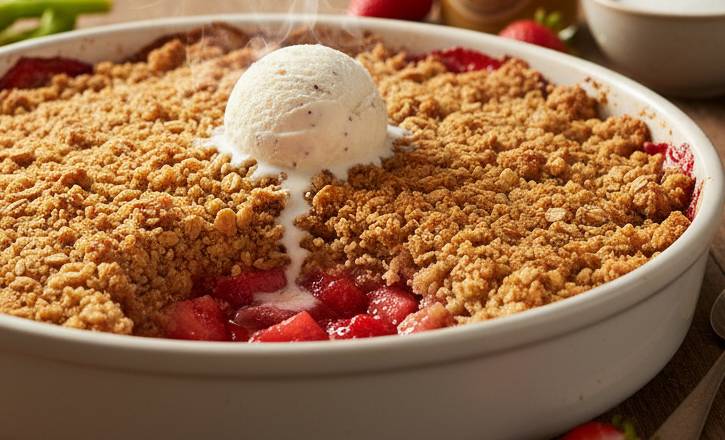
Bake at 350°F (175°C). We are looking for the fruit juices to bubble thick at the edges and the malt topping to turn a deep, golden mahogany. This usually takes 35 to 45 minutes.
The Presentation
A dish like this should be served warm, but not hot. Allowing it to rest for 15 minutes lets the pectin set, ensuring a clean spoonful. Serve it in a shallow bowl with a quenelle of lightly sweetened crème fraîche or a high-quality vanilla bean ice cream. The acidity of the dairy will cut through the richness of the malt and the tartness of the rhubarb.
When you master the fundamentals of temperature and timing, even the simplest dessert becomes an extraordinary experience.
FAQ
1. Why do you recommend macerating the fruit before baking?
In a professional setting, we seek to control every variable. Rhubarb and strawberries have high water content. By macerating them with a little sugar beforehand, we draw out that excess moisture. Reducing that liquid into a syrup and adding it back ensures a concentrated flavor profile and prevents the “soupiness” often found in amateur crumbles.
2. Can I substitute the malt powder if I cannot find it?
While the malt provides a unique, toasted depth that defines this specific dish, you could substitute it with a high-quality milk powder for creaminess or finely ground toasted hazelnuts. However, the malt is the key to achieving that specific “cereal” nostalgia that balances the tartness of the rhubarb.
3. My crumble topping is often too soft. How do I achieve a crisp texture?
Texture is a result of temperature management. Ensure your butter is “fridge-cold” when mixing. If the butter melts before it hits the oven, the topping will be heavy. Furthermore, do not overwork the dough; you want distinct “pebbles” of flour and butter that will crisp up individually in the heat.
4. How do I know when the rhubarb is perfectly cooked?
We look for the “knife-tender” stage. The rhubarb should hold its geometric shape but offer no resistance when pierced with a paring knife. If it becomes a purée, it has been overcooked. This is why we cut the stalks into 1-inch pieces—to ensure they survive the bake while softening completely.
5. Is it necessary to peel the rhubarb?
Generally, no. For field-grown rhubarb, the red skin provides the beautiful pigment we desire. Only if you are using very late-season, oversized stalks that have become fibrous should you lightly peel the exterior. In most cases, the heat of the oven will break down the fibers sufficiently.
6. Can this dish be prepared in advance?
You may prepare the malted crumble topping and the fruit separately up to 24 hours in advance. However, do not combine them until you are ready to bake. If the topping sits on the raw fruit for too long, it will absorb moisture and lose its ability to become crisp.